In today’s data-driven world, businesses and organizations rely heavily on the power of data to make informed decisions, drive growth, and stay competitive.
This course covers the entire data analytics pipeline, starting from data collection and cleaning to analysis and visualization. You will be introduced to key concepts such as data mining, exploratory data analysis, statistical methods, and predictive modeling. By the end of the course, you will be able to apply various analytical techniques using popular tools and platforms like Microsoft Excel, SQL, Python, and Tableau.
Data Analytics Course
In today’s data-driven world, businesses and organizations rely heavily on the power of data to make informed decisions, drive growth, and stay competitive. Our Data Analytics course is designed to equip learners with the essential skills and tools required to collect, analyze, interpret, and visualize data effectively. Whether you are a beginner aiming to start a career in analytics or a professional looking to enhance your data-driven decision-making capabilities, this course offers comprehensive learning that caters to a wide range of learners.
This course covers the entire data analytics pipeline, starting from data collection and cleaning to analysis and visualization. You will be introduced to key concepts such as data mining, exploratory data analysis, statistical methods, and predictive modeling. By the end of the course, you will be able to apply various analytical techniques using popular tools and platforms like Microsoft Excel, SQL, Python, and Tableau.
A significant emphasis is placed on hands-on learning. Through real-world case studies and practical exercises, students will gain the confidence to work with large datasets, derive meaningful insights, and present data-driven solutions to stakeholders. This approach ensures that learners not only understand theoretical concepts but also gain practical experience that is directly applicable in the industry.
Introduction to Data Analytics
What is data analytics? Importance and applications
Types of analytics: Descriptive, Diagnostic, Predictive, Prescriptive
Overview of data analytics tools and software
Data Collection and Data Types
Data sources and data gathering techniques
Structured vs unstructured data
Data formats and storage
Data Cleaning and Preprocessing
Handling missing data and outliers
Data transformation and normalization
Data quality and validation
Exploratory Data Analysis (EDA)
Data visualization basics
Statistical summaries and descriptive statistics
Identifying patterns and trends
Data Visualization
Tools: Excel, Tableau, Power BI, matplotlib, Seaborn
Creating charts, graphs, dashboards
Best practices for visualization
Statistical Analysis
Probability and distributions
Hypothesis testing
Correlation and regression analysis
Introduction to Databases and SQL
Basics of databases and relational DBMS
SQL queries for data extraction and manipulation
Joins, aggregations, subqueries
Data Analytics Tools and Programming
Introduction to Python or R for analytics
Libraries: Pandas, NumPy, Scikit-learn (Python)
Writing scripts for data manipulation and analysis
Predictive Analytics and Machine Learning Basics
Introduction to machine learning concepts
Common algorithms: Linear regression, decision trees, clustering
Model evaluation and validation
Big Data Fundamentals
Overview of big data technologies
Hadoop, Spark basics
Data lakes and warehouses
Business Intelligence (BI)
BI concepts and architecture
Creating reports and dashboards
Using BI tools for decision making
Capstone Project
End-to-end data analytics project
Data collection, cleaning, analysis, visualization, and presentation
Soft Skills and Communication
Presenting insights effectively
Storytelling with data
Collaboration with stakeholders
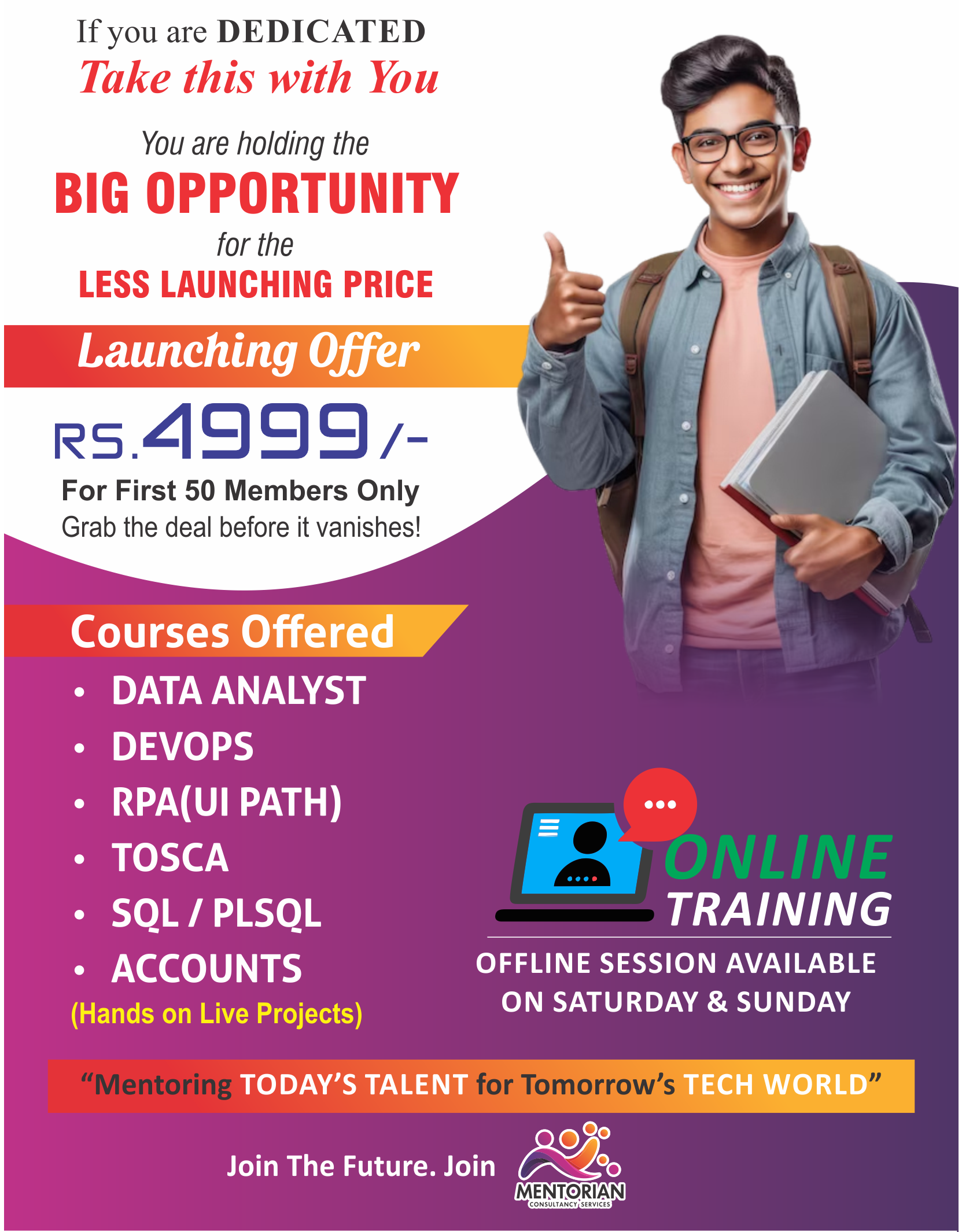
Mentorian offer various modes of training to cater to different learning preferences:
Offline Classroom Training: In-person sessions conducted at training centers.
Online Live Sessions: Real-time interactive classes conducted over the internet.